
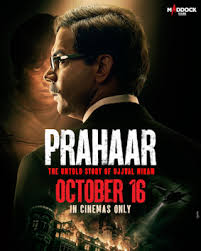
 By Neber Haque, Big Bollywood Buffs
I went into Prahaar expecting the familiar playbook. Since Operation Sindoor and the Pahalgam attack last year, filmmakers and production companies have moved quickly to apply to register titles such as Mission Sindoor, Sindoor: The Revenge and The Pahalgam Terror. The commercial logic is obvious: patriotism sells. So I expected flag-waving, an easily identifiable villain, and nationalism doing the work of storytelling. I came out thinking about something else entirely. What it means to earn justice, even when the verdict seems inevitable.
The film is based on the life and work of public prosecutor Ujjwal Nikam and the trial that followed the 26/11 Mumbai terror attacks, one of the most closely watched prosecutions in Indian legal history. Before I watched it, I had not heard of Nikam. Afterwards, I looked him up, watched his interviews, and found myself reconsidering where the film’s portrait ended and the real man began. That is the highest compliment I can give a biographical film.
The Case for Due Process
The film plays as though everyone in that courtroom already knows the truth. The judge, the defence, the accused. The uncertainty seems to lie not in guilt but in how the case will be proved. And yet Ujjwal Nikam fights for evidence, for confession, for the procedural record. Not because the outcome is in doubt, but because the outcome only means something if you earn it properly.
That is the film’s central argument, and for much of its running time, it makes a compelling case for it. India’s claim to be the world’s largest democracy is not proved by saying it. It is proved by what you do inside a courtroom when the whole world is watching. That is the film’s vision of justice, and director Avinash Arun Dhaware builds towards it with real patience.
Whether the film always earns that argument dramatically is a more interesting question. There are moments where it asks the audience to admire Nikam because the moral stakes are obvious, rather than showing us the procedural difficulty of establishing guilt. The principle is stated more often than it is dramatised. But in its best scenes, the film does the harder thing.
Rajkummar Rao 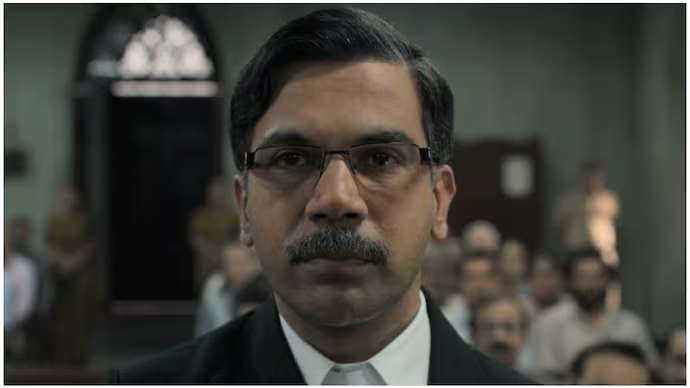
I have seen Rajkummar Rao in many films, typecast and otherwise. I cannot remember a character like this.
Nikam is not a young hero. He is a father, a husband, a grandfather. A man carrying decades of life and work in every scene. Rajkummar Rao plays him as someone who believes in his work rather than someone trying to look heroic, and the distinction matters enormously. Watch the scene where Nikam delivers his closing statement. Rajkummar Rao does not reach for the obvious emotional register. He stays inside the procedural rigour of the man, and the emotion arrives through the restraint. I have not seen him do that before.
The father-son relationship is handled with the kind of restraint that South Asian cinema rarely manages well. It is not that they don’t love each other; it is that neither of them has the language for it. The distance between them is not conflict. It is the particular silence of men who carry everything privately. In a film preoccupied with the public demands of justice, this quiet exchange may be its most revealing moment of private life.
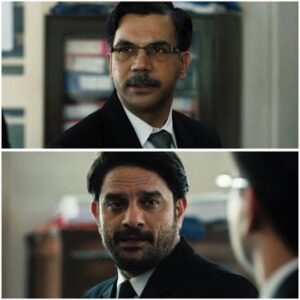 Jaideep Ahlawat
Director Avinash Arun Dhaware has worked with Jaideep Ahlawat before, and he uses that trust well here. Jaideep Ahlawat plays Chaudhary Zulfiqar Ali, a Pakistani prosecutor who becomes an unlikely counterpart to Nikam. Two men on opposite sides of a national boundary who find, in their shared commitment to the process, something that functions almost like friendship.
His presence in the film changes Rajkummar Rao’s performance. There is a scene between them where the register shifts, where Nikam briefly stops being a prosecutor and becomes a man talking to another man. Ahlawat does almost nothing to signal this. He simply relaxes the formality of the meeting, and Rao’s Nikam follows. For a moment, the two men seem to step outside their official roles. That shift is what makes Ahlawat’s cameo worth far more than its screen time.
Direction and Visuals
The film opens in compressed, underlit interiors. The palette is close to monochrome in the early courtroom scenes. Dark suits, dark wood, a world that feels sealed against air. As Nikam approaches his closing statement, something changes. The lighting opens up, the frames feel less compressed. It is a thoughtful visual choice, allowing the film’s emotional register to shift without having to announce the shift in dialogue.
Avinash Arun Dhaware understands pacing in a way that many directors working in this genre don’t. He lets the procedural scenes run without rushing them, trusting that the audience will feel the cumulative weight of what is being built. That patience costs something. The film is not a quick watch. But it earns the closing sequence. The score follows the same discipline, knowing when to retreat. It is never the reason you feel something, but never the reason you stop feeling it either.
Where It Falls Short
The Pakistan sequence, Nikam’s visit, the meetings and the negotiations across a border, deserved more room. It feels rushed in a film that takes its time everywhere else, and the missed space is not just narrative. If the film’s argument is that justice transcends national interest, this is where it needed to make that case most specifically. It gestures at something important and then moves on.
Lalit Prabhakar’s portrayal of Kasab is compelling. There are moments where the performance hints at something interior, a person behind the act. But the screenplay does not fully meet that performance. If the film’s central argument is that even a terrorist deserves due process, then Kasab needs enough dramatic complexity to make that principle feel like a real test rather than a procedural formality. What Prabhakar finds in the role, the screenplay does not always support. Giving him more would not have softened the film’s moral position. It would have strengthened it.
Verdict
Prahaar is not the anti-Pakistan film its subject matter might lead you to expect. It is a more measured examination of justice, duty and the possibility of human connection across a national divide. Rajkummar Rao delivers one of the strongest performances of his career, finding the private vulnerabilities beneath a public figure’s conviction.
The film stops just short of exceptional. Its screenplay does not fully explore the complexities raised by its own argument, and the Pakistan sequence deserved more room to breathe. But its best moments understand something that many courtroom dramas overlook: justice is not simply about reaching the right verdict, but about how you arrive at it. I walked out having looked up a man I had never heard of, wanting to understand what he actually did in that courtroom. A film that sends you searching for the truth behind it has done something.
4/5