
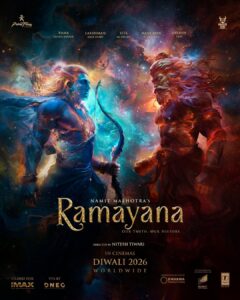
 By Neber Haque
My first introduction to Ramayana was when I had just finished Class 8. It was the summer vacation before Class 9, and I picked up Valmiki’s Ramayana and read it as a teenager. Every scene, every battle, every moment. I was building it all in my head, imagining what it would look like if it ever came to life.
That was 17 years ago.
Sitting in the cinema watching this film, I got that exact same thrill. That same sense of adventure I had as a teenager with a book in my hands.
Now, we all know the story of Ramayana. The morals, the journey, the lessons. They have been with us since childhood. So rather than talking about the story, let’s talk about what really matters here: the technical execution.
It is extraordinary.
What is most impressive is that this is a three-hour-plus film and you simply do not feel it. The direction keeps the scale completely under control. Every sequence has purpose, the pacing never drags, and the mythology never feels too big for the screen it is on. The quieter emotional moments are given just as much care as the action sequences.
Cinematographer Pankaj Kumar pre-visualised every single shot before a camera rolled, and you feel that precision on screen. The world of Ayodhya, the forest, the landscapes. All of it is lit and framed with intention, not simply rendered for spectacle. The CGI and visual effects then build on top of that foundation, and the result is something Indian cinema has rarely achieved. Two sequences in particular are unforgettable. The battle between Ram and the Rakshasas is visceral, easy to follow, and hits with real weight. The camera never loses you in the chaos. And the Jatayu fight, watching that great bird battle Ravan to protect Sita, is one of the most emotionally charged action sequences Indian cinema has produced.
Then there is the score. There was plenty of controversy before release about AR Rahman being chosen as music director. The decision to bring Rahman on board now feels entirely justified. He does not just score the action. He gives justice to every single scene on screen. The Jatayu sequence without that score would not have hit half as hard.
One detail that quietly moved us: when Ram, Sita and Lakshman leave the palace for their 14-year exile, they are wearing Khorom, traditional wooden sandals. A small detail, easy to miss, but it is there throughout. That kind of authenticity tells you exactly how seriously this film takes its source material.
Nevertheless, we have to be honest about the leads.
Ranbir Kapoor looks older than the age traditionally associated with Ram, and his body language and screen presence never quite convey the divinity and quiet authority the character demands. Even in the romantic moments with Sita, something felt missing.
Sai Pallavi faces a different but equally significant challenge. Sita is a character defined by grace, dignity and an inner strength that commands every room she enters. There is a scene where Sita addresses the people as they leave for exile. It should feel like a leader speaking with quiet power. Sai Pallavi delivers it, but she does not own it. The grace and authority the character demands simply weren’t there.
Now Yash as Raavan is a completely different story. Watch his confrontation with Vivek Oberoi. In that scene he holds two things at once, a chilling calm and a burning ego, without tipping into either. That is incredibly difficult to do and he makes it look effortless. He was made for this role.
Rakul Preet was outstanding. Vivek Oberoi, Kajal Aggarwal. Even in smaller parts they all left a mark.
Seventeen years ago, I was a teenager reading Valmiki’s Ramayana, imagining this very world in my head. This film not only met that imagination. It exceeded it. That is a rare thing. Almost impossibly rare.
We just wish the two people at the centre of that world had matched everything around them.
BBB Rating: 4.5 / 5